I first interviewed Coral Remiro in 2024. At that time, she was the farm manager at Earth Stewards, an urban farm in Kirikiriroa, Hamilton. We had a fascinating chat about the successful polycropping method she’d implemented on the farm.
What is polycropping?
Polycropping is a technique that involves growing different crops together in a garden bed instead of using the more traditional monocropping planting method. It can be used in a small garden or larger growing system.
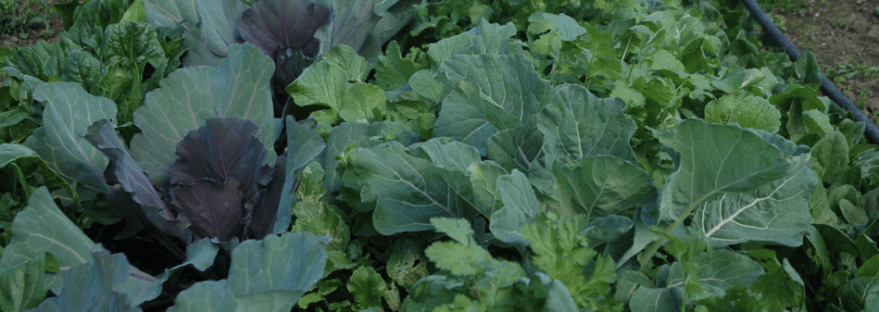
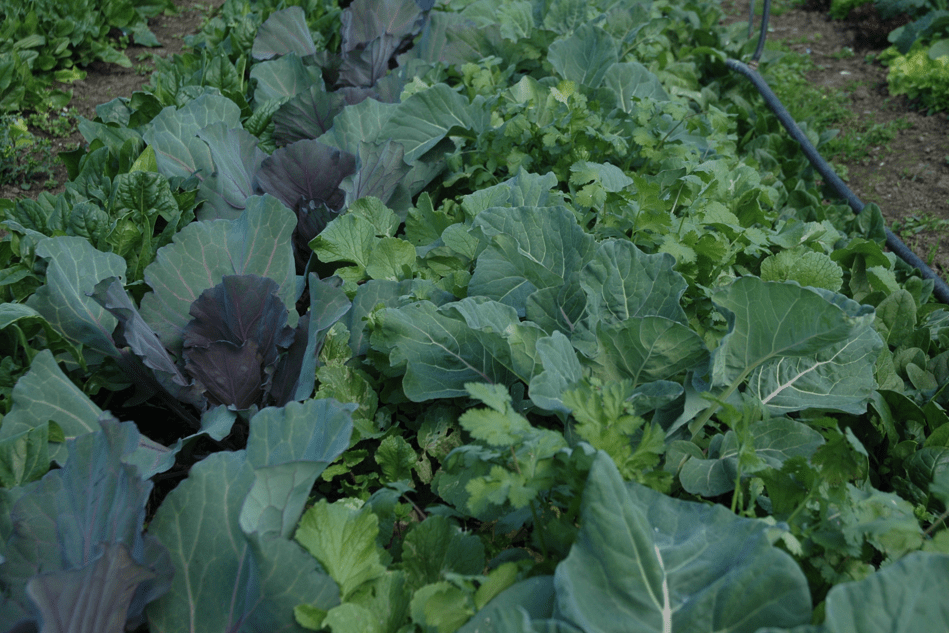
Spinach, cabbages, radish and coriander growing in a polycropping system
What are the advantages of polycropping?
Coral has found that one of the advantages of polycropping is an increase in the number of plants that can be grown in a small space. This has created more space to plant cover crops. She says, this has been a game changer as the cover crops reduce weed pressure, add a source of nitrogen, and provide more compost material.
Polycroppingalso increases biological diversity in and above the soil, directly helping to maintain a balanced system. Different insects, microorganisms, and other animals are attracted to the different habitats provided by different plants in close proximity.
Is polycropping complicated?
Polycropping is complicated until, as Coral says, “you can get your head around it.” She does not spend time these days considering companion planting so much as thinking about how plants grow. She explains that there are some key concepts to consider when grouping plants together including:
how much space is available around a plant as it grows
how long it takes for each type of plant to reach harvest size
light requirements for each plant
how different plants grow – vertically or horizontally
if the plants are root or leaf crops.
Hero plants
In her planning Coral thinks about how to create guilds – groupings of plants that support each other. She has found the best way to plan her garden is to organise plants into groups based on how long it takes for them to grow to harvest size:short, medium, and long-term. Plants like tomatoes and brassica take the longest to grow and she says these are the ‘hero’ plants. She suggests using these plants as a base to work around and then planting faster growing and smaller plants around these, for example, coriander and radish.
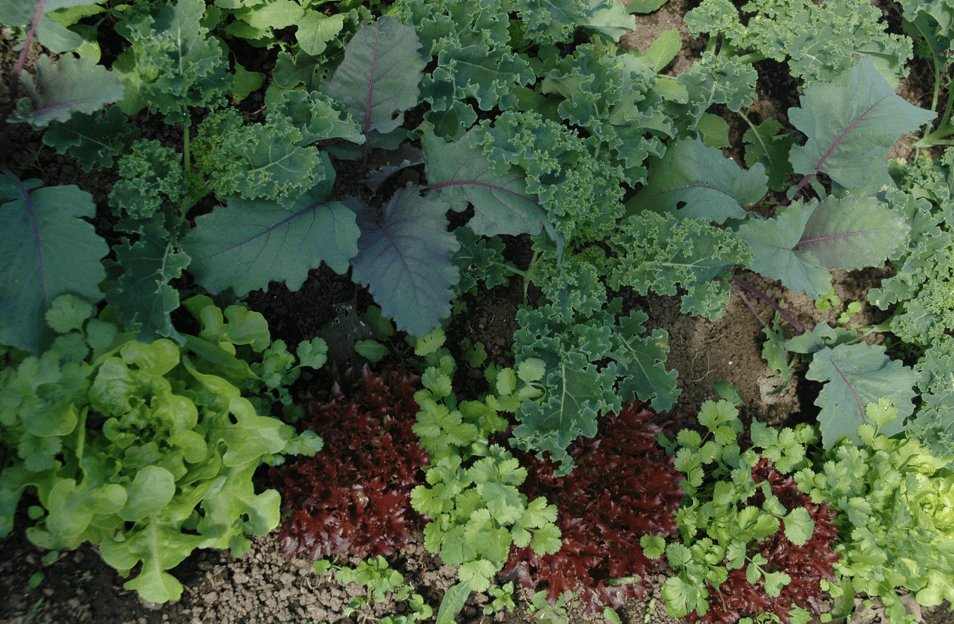
Kale, lettuce and coriander
The importance of record keeping
Like all gardeners and growers, Coral has learnt some lessons the hard way. For example, she planted lots of beetroot plants around other plants without considering how much light they needed. She says, one of the keys to success in polycropping is observation and recording what works well and what doesn’t. I would also suggest taking a photo before you forget – seasons pass fast!
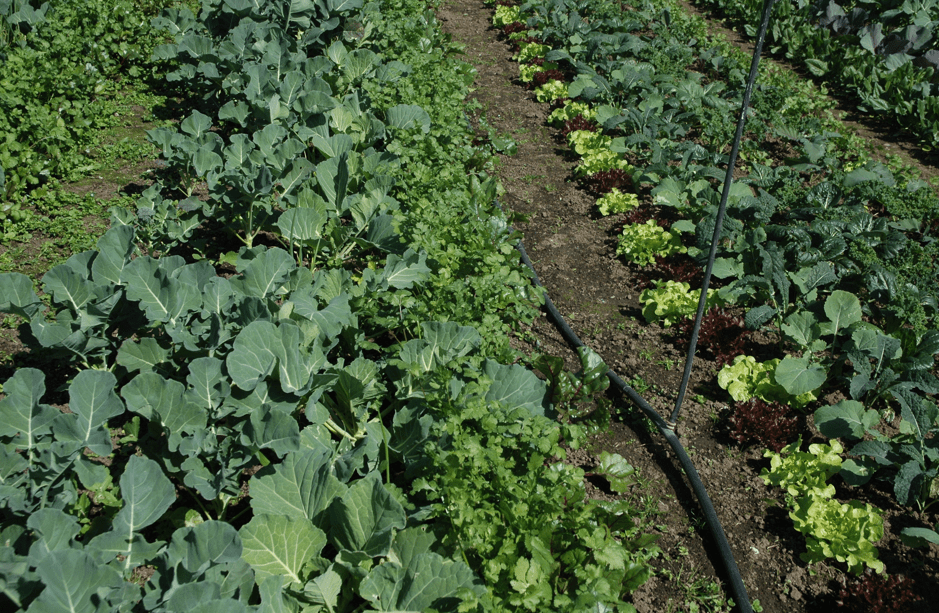
Brassica surrounded by a range of plants including lettuce and coriander
What I really appreciated when talking to Coral was her openness to trying new things in the garden. I also valued her approach to creating diversity. It’s always good to remember that in a garden, diversity can mitigate risk.
Visiting Earth Stewarts Urban Farm https://earthstewards.nz/ and chatting to Coral was an inspiration.
It’s certainly a challenge managing those creatures that are in the wrong place in your garden. Knowing what to do and who to believe is difficult when you find an animal decimating your carefully tended crop.
Having a baseline can help us make garden decisions. With this foundation, plans can be made in line with your own ethics, climate, needs, and the surrounding environment. My aim is to grow organically, and I also try to create a diverse environment. This approach helps with my decision making.
Slugs and snails
An explosion of snails and slugs in any garden is an ongoing problem, especially during damp conditions. Most gardeners will attest that it’s pretty hard to get rid of any one species of animal permanently. Yet, there are some things you can do that can help create a balance.
One way is to create habitats for the animals you want, while working to reduce the habitat of those you don’t. Some birds, like thrushes and blackbirds, eat snails and slugs so we encourage them. We try to create bird habitats with lots of trees and some scrubby areas. However, we also try to remove hiding places for slugs and snails. We do this by keeping the grass short close to the garden beds.
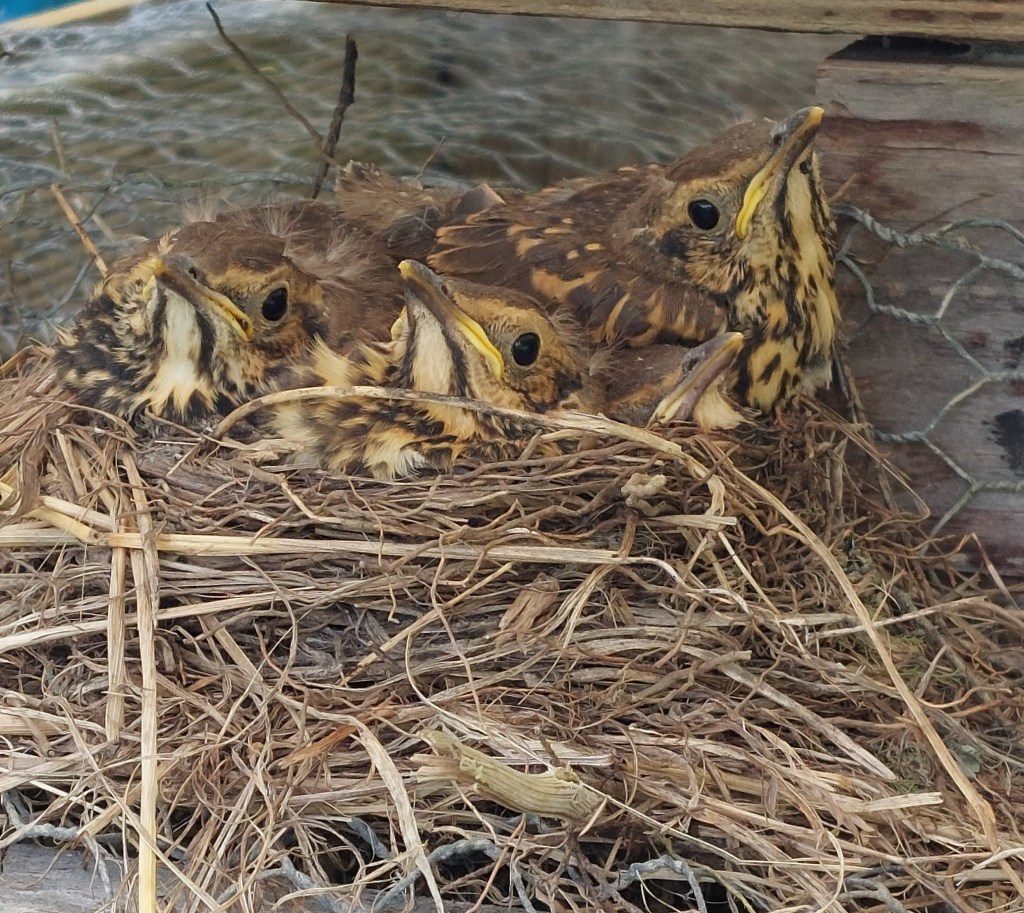
Without a cat around Mamma Thrush decided to have her babies close to ground level.
Another popular method is to place pots upside down on the garden patch. This encourages snails to gather. Then, you can move them away from the garden. Be sure to take them far enough away as they will work hard to find their way back!
Slugs and snails particularly like smaller or weaker seedlings, so strong healthy plants are often less vulnerable. Growing some seedlings larger before planting them out in the garden has been a game changer. This is especially true for those plants that are vulnerable. You can read more about this here.
Sometimes it is also worth allowing one plant to act as a sacrificial plant. Leave it in place to let the slugs and snails eat it. This way, others can continue to grow strong. It seems counter intuitive, but we have had some success trying this method.
It’s also good to observe your garden to see what is chewing on your plant. Check at different times of the day. What looks like slug damage may in fact be something else.
Larger animals
You can protect your plants from seed and fruit eating birds by using netting. This method also works against small mammals. It’s a good idea to use netting that is small enough, so birds won’t get caught in it. Always keep a close eye on it and check daily in case there are issues.
Covering seeds in the ground with a green shade cloth can protect them before they germinate. This prevents seeds from being disturbed by birds. For carrot seeds this also helps to keep the soil moist which helps the seeds germinate.
Insects
Celebrate insects! It means you have diversity. But of course, you don’t want to lose all of your crops to an overpopulation of certain insects. Having a wide variety of plants in a garden is therefore very beneficial. Diverse plantings help diverse insect populations thrive.
Flowers of different shapes and sizes will support different insects’ feeding habits. For example, the small hoverfly, often referred to as a beneficial insect, needs different things at different stages. At the larvae stage, they feed on insects like aphids. At the adult stage, they will need flowers for pollen and nectar.1
Flowers entice insects and humans alike!
Create permanent habitats to support beneficial insects. You may wish to keep a section of the garden for perennial plants. Alternatively, dedicate a row in your vege patch. This allows for some longer-term insect habitats.
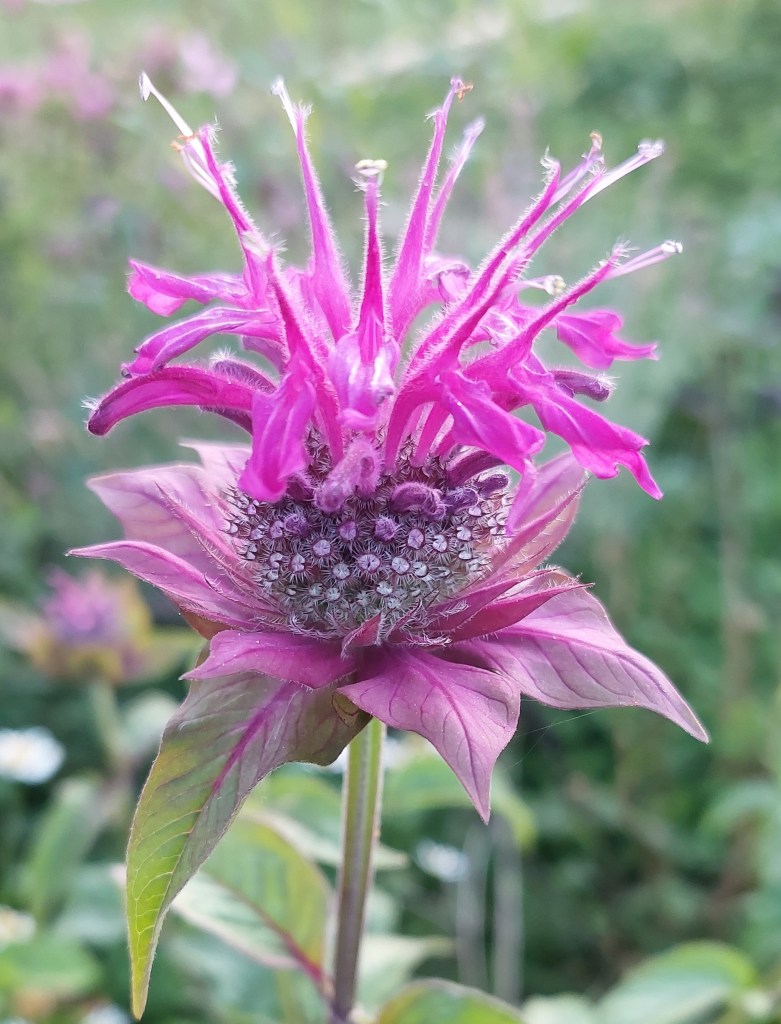
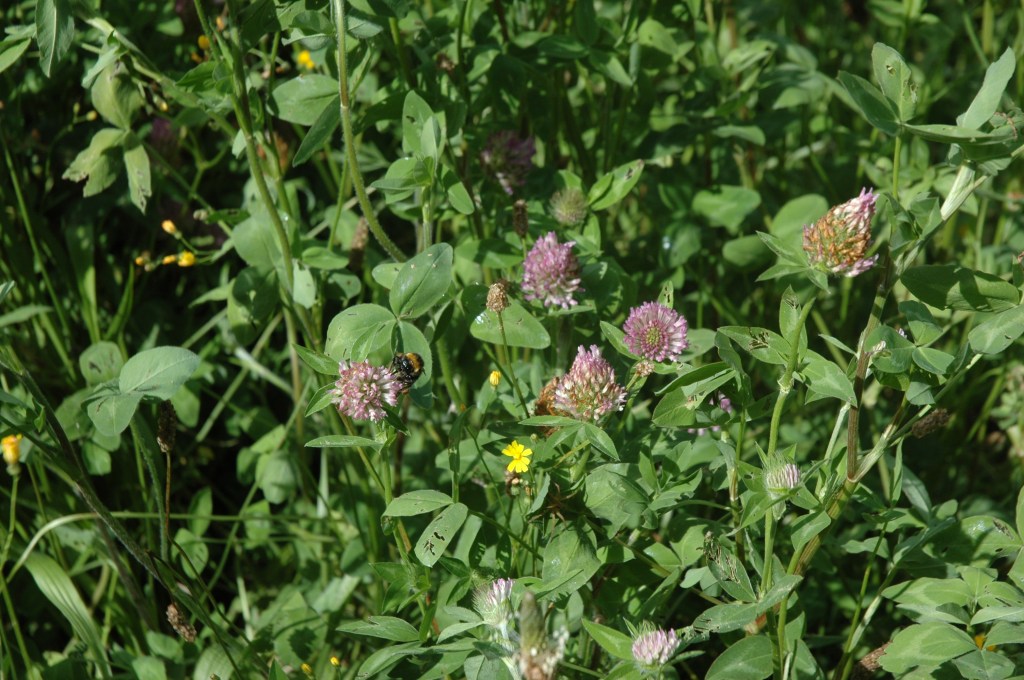
Aim to have flowers all year round, both native and introduced. Plant some eco-sourced natives to encourage native insects. Don’t forget about our native bees, ngaro-huruhuru. Other easy to grow plants to encourage beneficial insects include phacelia, alyssum, buckwheat, bergamot, cornflowers, chives and marigolds.
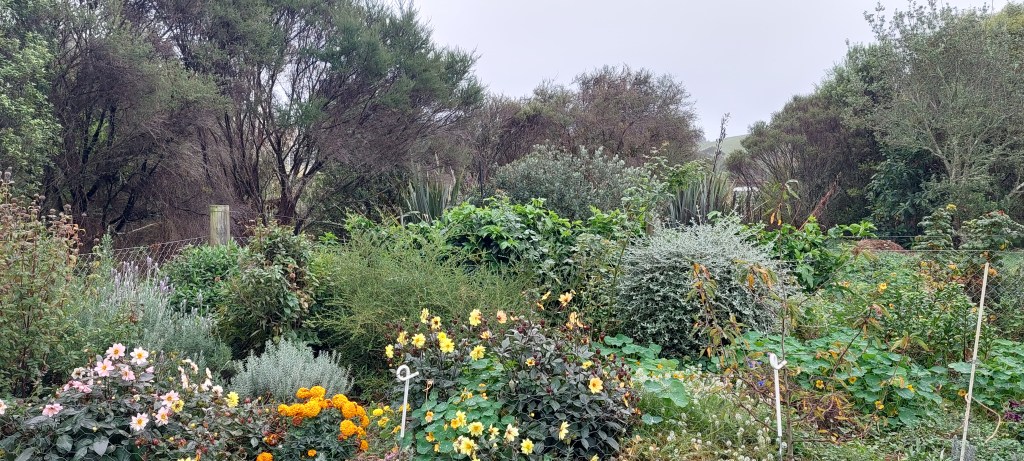
One of our wild and mostly perennial insect habitat plantings.
Spiders
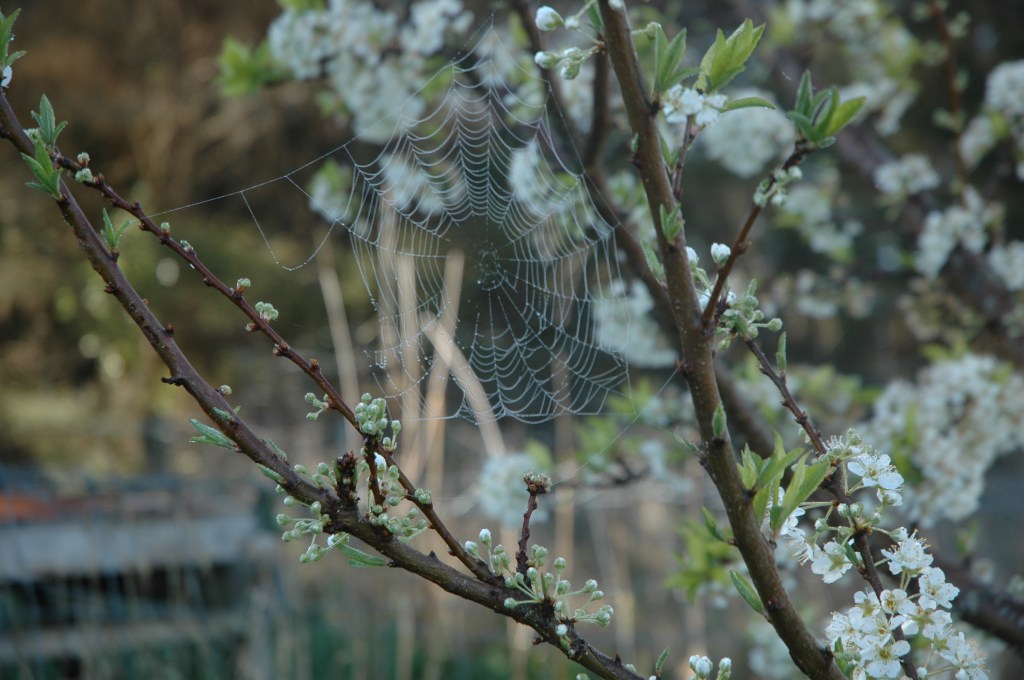
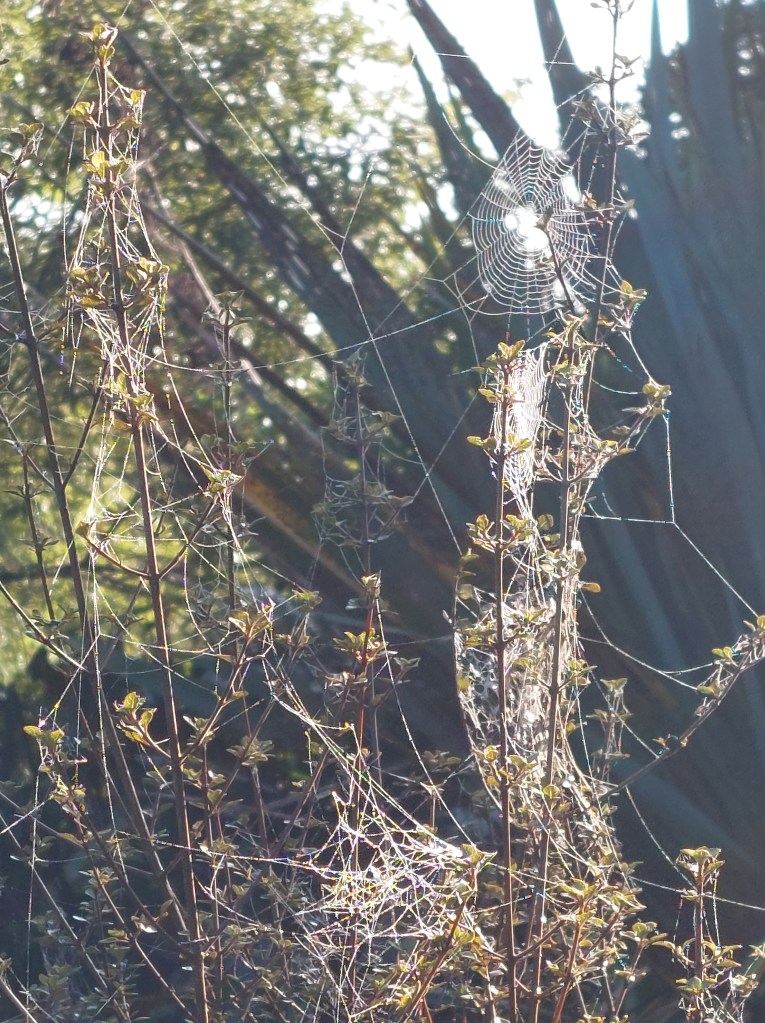
I’ll finish with the wonderful spider. They are a good sign that things are going well, and you have a diverse environment. They eat both the bugs you want and those you don’t. However, they can help prevent an imbalance of one species.
Above all experiment and play in the garden. Even commercial and experienced growers sometimes lose crops and must go back to square one. It’s also another good reason to create diversity and spread the risk.
Disclaimer The information provided on this site is for general guidance only. Users of the information contained on this site must make their own assessment of the suitability and appropriateness of the products, services and information for their particular use.
In this interview, I chat to Iain Tolhurst from the UK about using woodchip on his farm.
I discovered Iain Tolhurst’s work when I Googled Veganic in 2016. Tolhurst grows certified organic food on leased land for a box scheme and farm shop in the UK. He has been growing without using animal inputs such as manures and blood and bone, on just under 20 acres (about 8 hectares) for 35 years. His farm was described in George Monbiot’s 2022 book Regenesis as “a genuinely regenerative, organic system”1 using no artificial or livestock inputs and creating a space for diversity and wildlife to return.
Tolhurst grows about 100 different varieties of vegetables on his farm. He uses a system of long seven-year rotations and times the planting of the various crops to fit their differing fertility needs. When a plot is at the end of five years, he takes it out of production for two years to build the soil fertility using green manures of legumes and wildflowers to which he also adds ramial woodchip.
It was his use of woodchip that I was particularly interested in when I asked for an interview. Woodchip offers a good addition to the growing toolkit of alternative solutions to using manures, other animal inputs or artificial fertilisers in gardens and growing systems.
Woodchip at Tolhurst Organics
While we are used to seeing woodchips around fruit trees, on ornamental perennial beds and in forest gardens, using it in vegetable beds often raises questions about nitrogen lockup and soil health. Nitrogen lockup can occur when a carbon-rich material, such as woodchip, creates an imbalance in the soil. However, Tolhurst agreed to the interview as he wanted to highlight the potential of using woodchip in horticultural growing systems.
At Tolhurst’s farm, they use woodchips in various ways; as a propagation substrate, a seedling mix, applying it directly to the plots to build fertility and as a weed suppressant on pathways in tunnel houses. However, he explains, the key to the system working and avoiding nitrogen lockup, is to use different forms of woodchip, appling it correctly, and timing the harvest of the woodchip.
Tolhurst sources the woodchip for the farm from local arborists and it comes from a mix of trees, usually from local gardens. Using local material also reduces the carbon footprint of transport, an issue with many fertilisers. Tolhurst explains that the woodchip is very different from wood shavings or sawdust, as using these would cause issues as they are difficult to compost.
Woodchipsandcomposting
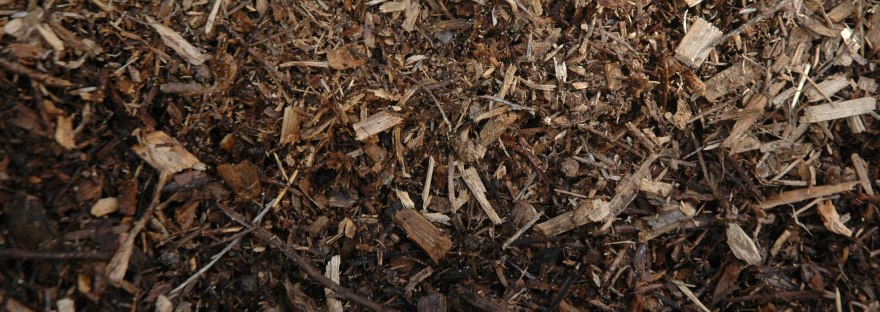
Once the woodchip arrives on the farm, it is composted in a long pile called a windrow. This is turned four times in the first year, after which it is applied directly in the tunnel houses as compost.
To make a seed-raising mix, they also keep some of this composted woodchip and continue composting it for another six months to two years. At this stage, it becomes very crumbly and there is not much visible woodchip left. They then grade it and add a little vermiculite. In Tolhurst’s experience he says, it acts as well as any peat-based material. Finding an alternative to peat-based material has been important in their search for alternative fertility-building materials, especially in potting mixes.
Ramial woodchip
Ramial woodchip is an exciting development in growing systems and growers are experimenting with its use. Ramial woodchip is chipped branch wood sourced from branches less than 7cm in diameter and excludes any wood from the tree trunk. The reason for using chipped branch wood is it has a lower carbon-to-nitrogen ratio than trunk wood and, as the chip is applied fresh, it retains many of the tree’s nutrients and energy in the chip.
Tolhurst explains that he uses ramial woodchip in very modest amounts and adds this into the green manure phase of the growing system. Because they are in the UK, most of their ramial woodchip is harvested in winter and this works well as many of their indigenous trees are deciduous.
At Flowering Bean Organic Gardens, we are exploring using ramial woodchip from introduced deciduous trees and may experiment with some branches from native non-deciduous trees. Not scientific, but certainly a fun to experiment to see what happens in our growing system.
A mixed cover crop that has had ramial woodchip added for fertility Flowering Bean Organic Gardens
Woodchips on pathways
The other application of woodchips at Tolhurst Organics is the more traditional use of woodchips on pathways. The advantage, Tolhurst explains, is that the woodchip suppresses weeds and adds fertility as it breaks down and the fertility moves across into the beds carried by microorganisms. They lay it about 7cm thick and it reduces weeds for about 2 to 3 years before it is topped up again.
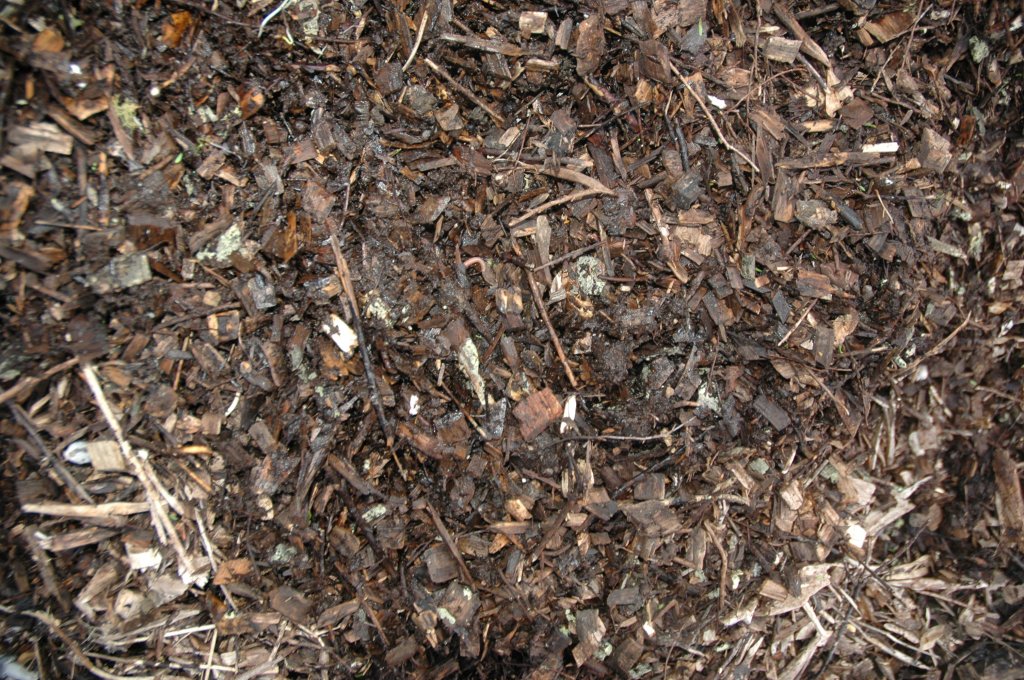
Spot the worm! Woodchip pile full of worms at Flowering Bean Organic Gardens
Talking to Tolhurst and learning more about the innovations on his farm, was certainly inspiring and I know there are many here in Aotearoa trying out new systems and ideas in both commercial and residential gardens. I hope this interview inspires and provides an introduction to the huge topic of using woodchips for fertility.
For anyone wanting to do a deep dive into using woodchip in gardens and farms, I found the Woodchip Handbook, A Complete Guide for Farmers, Gardeners and Landscapers by Ben Raskin and published by Chelsea Green Publishing had lots of great information.
Don’t forget to always consider your safety when working with woodchip and compost materials. Here are some links to more more information about protecting your health when working with composting material.
Unseen below ground is a vast world, teeming with life. Well at least we hope so… but sadly so much of our soil is now depleted. However, we still have time to restore the richness of the soil by increasing the crucial levels of beneficial microorganisms, fungi, and bacteria.
But what about the humble earthworm – including our native species? Like most gardeners, I’m excited to see earthworms in the garden and wonder if we tend to know intuitively that they are good for fertility and soil health, but I suspect most of us know very little about them. To delve into the topic of earthworms, I talked to Prof Steven Trewick, Professor in Evolutionary Ecology at Massey University.
Earthworms are specialists
Earthworms belong to the group of invertebrate animals known as annelids, or segmented worms, which include more than 20,000 species around the globe. They are highly diverse in the way they live, but because they dehydrate in the open, they are constrained to living below the surface of the soil or in the sea.
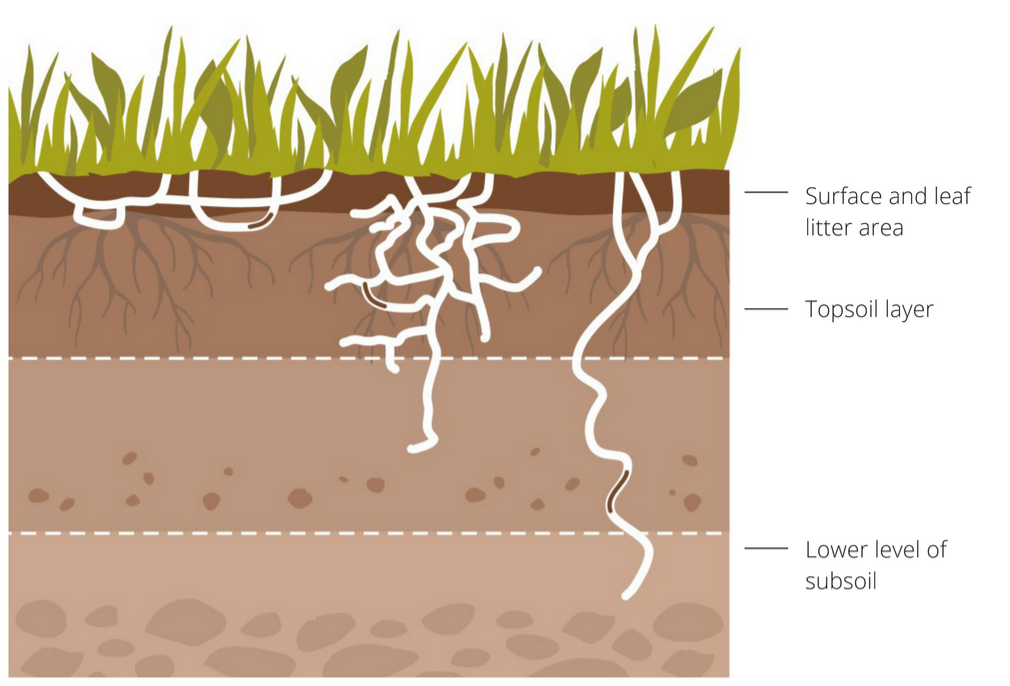
Trewick describes how earthworm species are specialised to different areas and the ground can be partitioned into three zones where the different species live:
Epigeic earthworms live in the surface and leaf litter area and break down dead organic matter.
Endogeic earthworms live in the in the topsoil layer and create horizontal burrows.
Anecic earthworms live in the lower level of subsoil. They make permanent vertical burrows and glean nutrients from minerals and organic matter. These subsoil species can be big and include a bioluminescent species of native worm known as Octochaetus multiporus that can grow up to 30cm long1.
Some of the introduced worms are specialists of pastures and others thrive in gardens, while the tiger worm mostly lives in compost heaps and doesn’t do well if moved into the garden. As Trewick says, it shows us how different the ecologies of different species are.
New Zealand’s native earthworms
Aotearoa New Zealand is also home to around 180 native species of earthworms and Trewick says we are finding more species all the time. The native earthworms belong to the family of Megascolecidae, and they live across our country’s forestlands.
However, Trewick says we don’t know if native worms are surviving around the country, and the general view is that as you get into pasture and urban areas the native worms disappear. But those are two correlated observations (one observation that appears to be related with another), and it might not be completely cause and effect; there may be more going on in the deeper soil. However, these days when we see a worm in our gardens or above soil after rain, it is likely to be one of the introduced Lumbricidae earthworms. These species were brought to Aotearoa New Zealand from Europe.
Garden fertility and earthworms
Worms create burrows and pores in the soil, which aid growth by aerating the soil and creating space for water and root growth. They also break down, move and recycle organic matter, creating richer and more diverse soil structure which is very important for plant growth. Pavlis (2020) suggests the microbial activity in worm casts is 10-20 times higher than it is in soil.2 Trewick says, that like every animal on the planet, it’s the microbiome associated with their gut that enables them to do what they do.
The study of soil microbiology, earthworms and fertility is complex and ongoing, but most of gardeners and growers will agree, the presence of earthworms is a pretty good sign in a garden.
How can we support earthworm populations?
To support earthworms, first and foremost, we need to think of our gardens as habitats. Trewick says, “Diversity is the answer; the garden shouldn’t be thought of as some sort of clinical formalised arrangement of things. You have to allow the process to work. Having a messy garden is good for diversity. We have to share the space a bit.”
“It’s not how you grow stuff, it’s how you dump stuff!”
This fantastic quote from Trewick is a perfect way to describe what we need to be thinking about in our gardens. Aim to always be increasing organic matter — mulch, mulch, and more mulch. This has several functions; it keeps your soil moist, providing a safer environment for the worms and microbiology; and it provides organic matter and food. This in turn decreases the need to cultivate, which helps increase your worm population. Read more about mulching here.
“It’s not how you grow stuff it’s how you dump stuff”
To support earthworm populations Trewick suggests that gardeners:
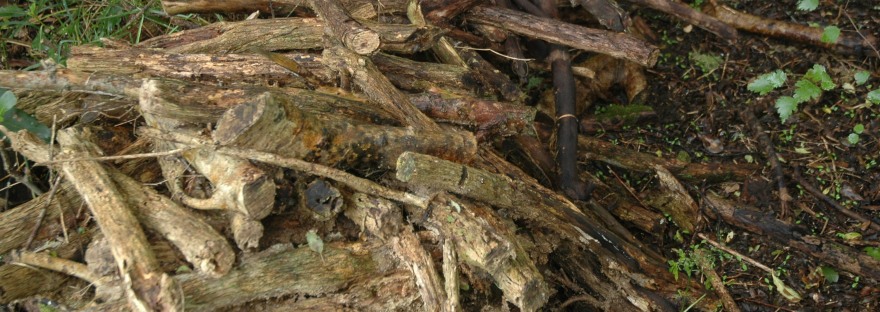
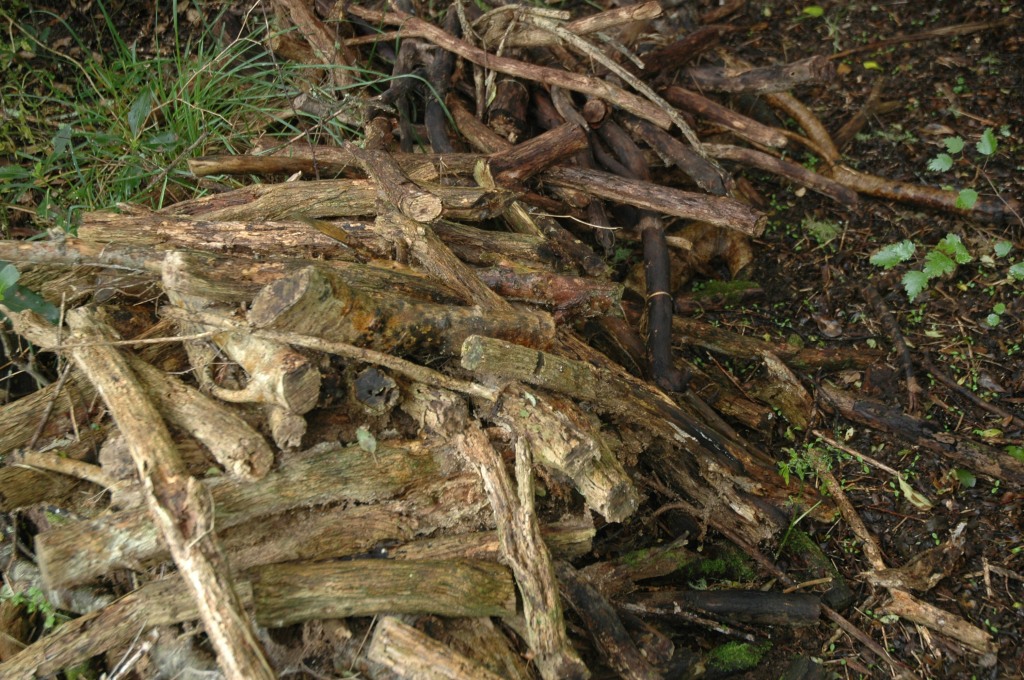
leave things to break down, be it a pile of logs or leaf litter
keep the circle of fertility going by giving back regularly
keep compacted areas to a minimum – reduce pathway size between beds and keep heavy machinery off your gardens
use low or no till to reduce the disturbance to earthworms and microorganisms
reduce or stop using pesticides and herbicides.
Perennial plants are also a bonus for earthworms because you can create undisturbed habitats where they can thrive. You can read more about perennial plants here.
How can we design our gardens to support earthworms?
The edges are an importance part of our human spaces. The edges are where diversity can thrive; our forests and scrub edges encourage a crossover of diversity into more cultivated areas. However, Trewick says, one problem is our large-scale paddocks as they can be overwhelming to native fauna.
In a home garden too, when we design our vegetable patches as highly controlled zones, surrounded by single species lawn and clipped hedges, we are reducing habitat. Trewick suggests, if we do feel the need to control the vege or flower patch, we can have ‘messy’ edges where biodiversity can flourish. Who knows, maybe there might be some bio-luminescent native earthworms trolling down there!
Messy edges in a home garden can support earthworms
Further resources
Wild Life New Zealand Textbook focusing on the unique plants and animals of Aotearoa by Trewick, S & Morgan-Richards, M. Phoenix Group Evolutionary Ecology & Genetics @ Te Taha Tawhiti https://evolves.massey.ac.nz


 flowering bean organic gardens